




How to Prioritise Local Business Leads Using Meaningful Business Signals
How to Prioritise Local Business Leads Using Meaningful Business Signals
slug: prioritise-local-business-leads-business-signals
Business Signals vs Business contacts which one converts to sale?
Meta title: How to Prioritise Local Business Leads More Effectively
Meta description: Learn how to rank local business prospects using fit, activity, contractibility and relevance instead of treating every collected lead equally.
Excerpt: Not every business lead deserves the same immediate attention. A simple, transparent prioritisation model helps sales teams focus on the prospects most likely to benefit from a relevant conversation.
Focus keyphrase: prioritise local business leads
Feature image: images/04-prioritise-local-business-leads.png
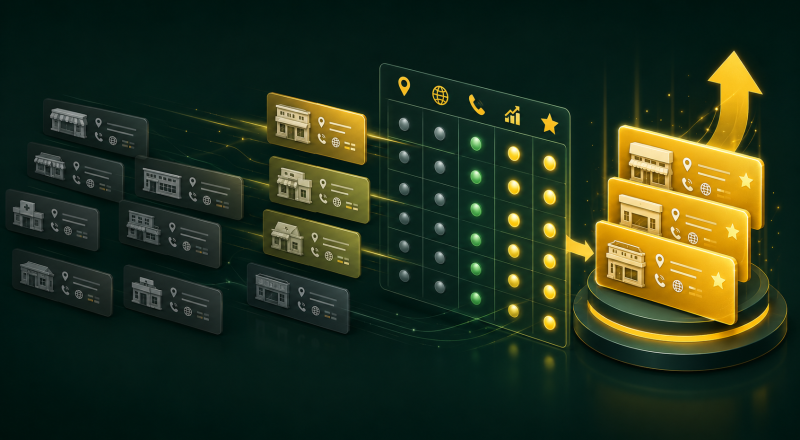
Feature image alt text: Local business prospect cards being ranked by relevant qualification signals
A newly collected lead list often creates the illusion of progress. Hundreds or thousands of business records appear in a database, and the next step seems obvious: start contacting them.
But a list is not a priority system.
Some businesses closely match the intended customer profile. Others are only loosely relevant. Some have sufficient information for a useful introduction; others require more research. If the team treats every record equally, its best opportunities can become buried inside low-fit data.
Lead prioritisation solves this problem by arranging prospects according to visible, explainable signals. The goal is not to predict the future with false precision. It is to decide where limited research and outreach time should be used first.
Begin with fit, not enthusiasm
Before creating a score, define what makes a business suitable for the offer.
Useful fit dimensions may include:
Industry or service category
Geographic area
Business model
Number of locations
Likely operational scale
Services currently offered
Compatibility with your delivery capability
A genuine problem your offer can address
A prospect should not receive a high priority simply because it has an attractive website or many reviews. Those may indicate activity, but they do not establish relevance. Fit must come first.
ABISTORES can help teams collect businesses by niche, location, rating and keyword, then organise the resulting records into segments. That creates a practical starting point for prioritisation without requiring the team to repeatedly rebuild spreadsheets.
Use four groups of signals
A clear prioritisation method can be built around four signal groups: fit, activity, contactibility and timing.
1. Fit signals
Fit signals answer: Does this business resemble the customer we can genuinely help?
Examples include the correct category, location, service type, branch profile or customer market. These signals should carry the greatest weight because a highly contactable business is still a poor lead when the offer is irrelevant.
2. Activity signals
Activity signals suggest that the business is operating and maintaining its public presence.
They may include:
Recent reviews
Current opening hours
An active website
Updated services or contact information
Multiple operating locations
Recent public business activity
Activity is useful for avoiding abandoned or stale records. It should not be described as buying intent unless there is direct evidence.
3. Contactability signals
Contactability measures whether the team has a suitable way to begin a conversation.
Possible indicators include:
A functioning website
A published business email
A valid telephone number
A relevant contact channel
Clear location or service-area information
ABISTORES can enrich collected records with available email, phone, website and related business details. This helps distinguish leads ready for review from records that still require research.
4. Timing and context signals
Timing signals are specific observations that make a conversation more relevant now.
Examples may include a newly opened location, a new service, an expansion into another area or a public change related to the problem your company solves. Timing signals must be factual and current. Avoid inventing urgency from weak clues.
Build a simple, transparent score
Complex scoring models can look impressive while hiding poor assumptions. Start with a method the team can understand and challenge.
For example:
Strong fit: 0–5 points
Active business presence: 0–3 points
Contactability: 0–3 points
Relevant timing signal: 0–2 points
Exclusion or risk condition: subtract points or suppress the lead
The numbers are not universal. What matters is that each point has a defined reason.
After scoring, group leads into practical bands:
Priority A: strong fit and ready for individual review
Priority B: relevant but needs more context or enrichment
Priority C: low urgency, incomplete or weak fit
Exclude: outside the target profile, duplicate, closed or unsuitable
The score should guide attention, not automatically send messages.
Add a reason, not only a number
A salesperson needs to know why the lead is prioritised.
Attach a short qualification note such as:
Matches the target category and service area
Operates three local branches
Website is active but enquiry pathway is limited
Requires telephone verification before outreach
Similar name found; possible duplicate
ABISTORES lead segments and CRM notes can keep these reasons visible beside the record, helping the next person understand the research rather than repeating it.
Separate priority from readiness
A high-priority lead is not always ready to contact. It may be an excellent fit but lack verified contact information. Conversely, a fully enriched record may be easy to contact but only weakly relevant.
Use two separate fields:
Priority: how valuable it is to investigate or pursue
Readiness: whether the record has enough verified information for the next action
This distinction prevents the team from contacting convenient leads instead of suitable ones.
Review the model against outcomes
After enough outreach activity, compare the prioritisation bands with real results.
Ask:
Which band produced the strongest reply rate?
Which signals were associated with meaningful conversations?
Which criteria added effort without improving decisions?
Were valuable prospects incorrectly placed in a low-priority group?
Did any signal introduce unfair or irrelevant assumptions?
Update the model gradually. Do not redesign it after every isolated result.
Keep human judgment in the process
Lead scoring works best as decision support. A person should still review context, message relevance and any reason not to contact the business.
Public data can be incomplete or outdated. Two companies that appear similar in a database may have very different needs. Human review protects quality and reduces inappropriate automation.
Prioritisation should create focus
A useful model does three things:
Moves strong-fit businesses to the front.
Explains why they were prioritised.
Makes the next action clear.
The process can be summarised as:
Define fit → collect signals → enrich → score transparently → review → act → learn from outcomes.
ABISTORES can support the operational parts of this process by keeping local business discovery, enriched details, segments and follow-up notes connected. The final decision remains with the team—but the information required for that decision becomes easier to find and use.
CTA: Use ABISTORES to collect, enrich and organise local business leads before applying your own transparent priority model.