




How to Keep Business Lead Data Fresh, Accurate and Ready for Outreach
How to Keep Business Lead Data Fresh, Accurate and Ready for Outreach
Suggested slug: keep-business-lead-data-fresh-accurate
Business outreach can be done with dump of old data
Meta title: How to Keep Business Lead Data Fresh and Accurate
Meta description: Learn how to maintain business lead data with verification dates, duplicate controls, bounce handling, ownership and regular refresh routines.
Excerpt: Business information changes constantly. A practical data-maintenance routine keeps lead records accurate, reduces wasted outreach and gives teams greater confidence in every campaign.
Focus keyphrase: keep business lead data fresh
Feature image: images/07-keep-lead-data-fresh.png
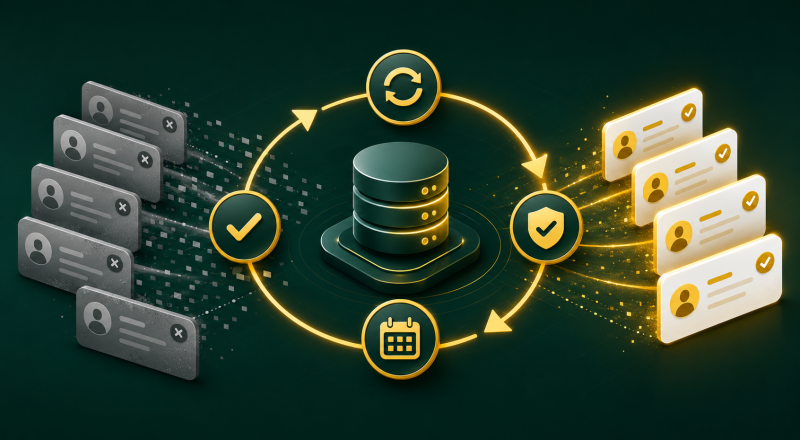
Feature image alt text: Outdated business contact cards being refreshed into verified lead records
A lead database begins ageing as soon as it is created.
Businesses relocate, change telephone numbers, redesign websites, add new services or close. Employees change roles. Email addresses stop working. A record that was useful six months ago may now direct outreach to the wrong place.
This does not mean business data is unreliable by nature. It means data quality is a continuing process rather than a one-time cleaning exercise.
Teams that maintain their lead information reduce bounced messages, duplicate contact, wasted research and embarrassing mistakes. More importantly, they can make decisions with greater confidence.
Define what “fresh” means for your workflow
Not every field changes at the same rate.
A business category may remain stable for years, while an email address can change quickly. A company’s website might be current even when a specific contact is no longer relevant.
Create freshness rules by field and campaign risk. For example:
Recheck telephone and website details before a high-priority campaign
Review older email addresses before reuse
Confirm the business still operates at the listed location
Revisit qualification notes when the offer or target market changes
Treat time-sensitive signals as expired after a short period
The appropriate interval depends on the market, campaign and consequences of using outdated information.
Record the source and verification date
Every important field should answer two questions:
Where did this information come from?
When was it last checked?
Store the original source, collection date and most recent verification date. When available information conflicts, preserve the evidence rather than silently overwriting one value.
ABISTORES helps collect local business information and available contact details into organised records. Adding a verification routine around those records allows teams to distinguish recently reviewed leads from data that should be checked before outreach.
Separate stable, changing and event-based fields
A useful maintenance model groups data into three types.
Stable fields
These may include the core business name, broad industry and established domain. They still require correction when evidence changes, but usually need less frequent review.
Frequently changing fields
These include telephone numbers, email addresses, opening hours, contact roles and social links. They deserve closer attention, particularly before a campaign.
Event-based fields
These describe a particular moment: a new branch, recently announced service, recruitment activity or another current business event. They can help provide timely context but should expire quickly unless reconfirmed.
Do not allow an old event to remain in a lead record as if it were still current.
Build a pre-campaign verification step
Before launching outreach, review the segment rather than trusting every existing field.
Check:
Does the business still appear active?
Does the website load and match the business?
Is the telephone number presented consistently?
Is the email address published or otherwise appropriately verified?
Is the category still correct?
Has the record opted out or been suppressed?
Is the qualification reason still relevant?
Is another team member already in conversation with the business?
ABISTORES lead segments can help isolate the exact campaign audience, making this final review more manageable than checking an entire database.
Treat delivery failures as valuable data
A bounced email or disconnected number is not merely a campaign statistic. It is a maintenance signal.
Create rules for outcomes such as:
Hard email bounce: stop reuse and mark for research
Soft bounce: retry cautiously according to policy, then review
Disconnected telephone: suppress the number and seek a reliable source
Website unavailable: check whether the domain changed or the business closed
Message returned as undeliverable: investigate before another attempt
Do not repeatedly send to a field that the system already knows is invalid.
Control duplicates at business and branch level
Duplicate records can be difficult to recognise because the information may not match exactly.
A business might appear under:
A legal name and trading name
Several location listings
Different telephone formats
Domains with and without www
Slightly different addresses
Old and new brand names
Use combinations of normalised business name, domain, telephone and address to find likely duplicates. Decide whether branches should remain separate based on how your organisation sells and supports customers.
ABISTORES CRM notes and pipeline status can provide another clue: two similar records with different active conversations require careful review before merging.
Give data quality an owner
When everybody is responsible for data quality, nobody may feel responsible for a particular correction.
Define who can:
Edit core business information
Merge duplicates
Change suppression status
Approve records for campaign use
Resolve conflicting fields
Archive closed or unsuitable leads
Keep an audit trail for sensitive changes, especially opt-outs and compliance-related fields.
Use clear record statuses
Useful data-quality statuses may include:
Recently verified
Ready for review
Requires enrichment
Requires contact verification
Possible duplicate
Stale
Suppressed
Closed or inactive
These labels make uncertainty visible. “Unknown” is more useful than an unverified value presented as fact.
Schedule small, regular maintenance
Waiting for an annual database clean-up allows quality problems to accumulate.
Use a layered routine:
Daily
Process bounces, opt-outs and obvious corrections
Record conversation outcomes
Merge confirmed duplicates encountered during work
Weekly
Review records missing owners or next actions
Investigate repeated delivery failures
Check newly collected high-priority leads
Before each campaign
Reverify the chosen segment
Confirm suppression rules
Review qualification and message relevance
Periodically
Identify inactive or stale records
Reassess category structures
Review data sources and quality patterns
Measure database health
Useful quality measures include:
Percentage of campaign records recently verified
Valid email and telephone rate
Duplicate rate
Bounce rate
Records without a source or date
Leads with missing qualification notes
Suppression errors
Average age of active records
The purpose is not to achieve a cosmetically perfect database. It is to know where uncertainty exists and prevent that uncertainty from creating poor outreach.
Fresh data supports respectful outreach
Accurate records reduce mistakes, but responsible contact still requires compliance with privacy, electronic-messaging and telemarketing requirements. Public information should be used thoughtfully. Honour opt-outs, maintain suppression lists and avoid using uncertain data simply because it is available.
The maintenance cycle is:
Collect → record the source → enrich → verify → use responsibly → capture outcomes → refresh or suppress.
ABISTORES can keep business discovery, available contact information, segments, campaigns and follow-up history connected. Combined with clear verification dates and maintenance ownership, that structure helps a lead database remain useful long after the original search.
CTA: Use ABISTORES to organise business leads and build a repeatable verification process around every campaign.