




How to Build a Qualified Local Business Lead List from Google Maps
How to Build a Qualified Local Business Lead List from Google Maps
Suggested slug: build-qualified-local-business-leads-google-maps
Out of square thinking can take you to great success.
Meta title: Build Qualified Local Business Leads from Google Maps
Meta description: Learn a practical workflow for finding, filtering, enriching and organising local business prospects from Google Maps for relevant outreach.
Excerpt: A large list is not necessarily a useful list. This step-by-step workflow shows how to turn local business discovery into a focused, outreach-ready lead database.
Focus keyphrase: qualified local business leads
Feature image: images/01-google-maps-qualified-leads.png
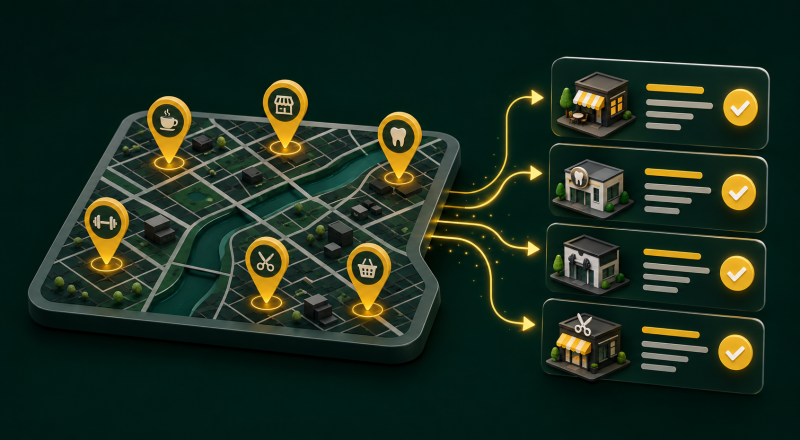
Feature image alt text: Local business map pins flowing into verified prospect cards
Finding businesses is easy. Finding the right businesses—with enough reliable information to begin a relevant conversation—is the part that requires a system.
Google Maps is a valuable starting point because it reflects how local businesses present themselves to customers. Listings can reveal location, category, website, telephone number, opening hours, reviews and other signals. But copying every visible result into a spreadsheet does not produce a qualified lead list. It produces raw data.
A stronger approach moves through five stages: define, discover, filter, enrich and organise.
1. Define your ideal customer before searching
Start with a clear ideal customer profile. If the target is vague, the results will also be vague.
Write down:
Business category or niche
Geographic area
Preferred company size or operating footprint
Minimum rating or review activity, when relevant
Website or contact requirements
Signals that indicate a likely need for your service
Conditions that should exclude a business
For example, “restaurants in Sydney” is broad. “Independent restaurants in selected Sydney suburbs with an active website, recent reviews and more than one location” is much more actionable.
The purpose is not to make the audience unnecessarily small. It is to prevent your team from spending time on businesses that were never a realistic match.
2. Search by niche and location combinations
Break a large market into manageable searches. Combine a specific business type with a suburb, city, postcode or service area.
Instead of running one search for an entire country, use focused combinations such as:
Physiotherapists in Parramatta
Accountants in Newcastle
Solar installers in Western Sydney
Independent gyms in Melbourne’s eastern suburbs
Focused searches make it easier to compare like with like. They also help you notice gaps, duplicate listings and local patterns that disappear inside a huge export.
ABISTORES can support searches by niche, location, rating and keyword, helping teams collect relevant local business records without repetitive manual copy-and-paste work.
3. Use visible signals to filter for fit
Not every listing should move into outreach. Add a qualification layer before enriching the records.
Useful signals may include:
Correct category and location
An active website
A working telephone number
Recent reviews or business activity
A service range aligned with your offer
Multiple branches or a growing geographic presence
Gaps your service can genuinely help address
Be careful not to treat ratings or review counts as universal buying-intent indicators. A high rating can show that a business is active, but it does not prove the business needs your product. Qualification comes from combining multiple signals with your ideal customer profile.
4. Enrich the records with usable contact information
A business name and map location may be enough for research, but outreach usually requires more.
An outreach-ready record can include:
Business name
Category
Address and service area
Website
General or role-based email address
Telephone number
Relevant social profile
Source and collection date
Qualification notes
Segment or priority
ABISTORES is designed to help enrich lead records with available emails, phone numbers, websites and other actionable business information. Enrichment should improve the record—not create false certainty. If a field cannot be verified, mark it as unknown instead of guessing.
5. Remove duplicates and standardise the data
Duplicate businesses can appear under slightly different names, branches or URLs. Before outreach, standardise common fields and check for duplicates using combinations of business name, domain, telephone number and address.
Also standardise:
Telephone formats
Website domains
Suburb and region names
Business categories
Status labels
Date formats
Clean data prevents two team members from contacting the same organisation and makes later reporting much more reliable.
6. Segment leads before writing messages
Do not send one generic message to the entire list. Segment prospects using the details that materially change the conversation.
Possible segments include:
Industry or service category
Location
Business size or branch count
Website present or absent
High, medium or low priority
New lead, contacted, replied or follow-up due
Segmentation allows you to explain why you are contacting that type of business and how your offer relates to its situation. Relevance is more valuable than volume.
7. Move leads into a visible follow-up process
A list becomes commercially useful only when the next action is clear. Every qualified record should have an owner, status and next step.
A simple pipeline might use:
New lead
Reviewed
Qualified
Outreach prepared
Contacted
Replied
Follow-up due
Converted or closed
ABISTORES combines lead collection, segmentation, templates and CRM follow-up visibility so the workflow can continue after discovery.
Keep outreach responsible
Business information being publicly visible does not remove the need for responsible outreach. Follow applicable privacy, electronic-messaging and telemarketing laws. Use accurate sender details, respect opt-outs, avoid misleading claims and contact only businesses for which the message is reasonably relevant.
The goal is not to contact the largest possible number of businesses. It is to build a smaller, better organised list and begin more useful conversations.
Turn local discovery into a repeatable system
The strongest local lead-generation workflow is not “search and export.” It is:
Define → discover → qualify → enrich → clean → segment → follow up.
When these stages remain connected, your team spends less time repairing spreadsheets and more time engaging with businesses that genuinely fit your offer.
Explore ABISTORES to build, enrich and organise your next local business lead list.